AI Can Do Your Books. Who Checks the AI?
AI can do a lot of your books now. Entering transactions, categorizing expenses, and reconciling accounts are tasks that once took a team, and software now handles many of them in minutes. That's a real shift, and we welcome it. We use AI every day at Calculated.
But a faster tool doesn't remove the need for judgment. It raises the stakes on it. The question is no longer whether AI can do your books. It's who checks the AI.
What AI does well.
AI is strong at repeatable, high-volume work. It sorts and categorizes transactions, matches records, drafts reports, and summarizes large amounts of data faster than any person can.
That changes the day-to-day. The manual entry that used to fill a bookkeeper's week is shrinking, and that frees up time for the work that actually moves a business: reading the numbers, spotting problems early, and making better decisions.
Where AI can go wrong.
AI makes a specific kind of mistake, and it's easy to miss.
It tells you what you want to hear. AI is built to be helpful, which often means agreeable. Tell it what you'd like your numbers to look like and it may oblige, even plugging in a figure to make things tie out.
It fills gaps with confidence. Instead of flagging what's missing, it produces a clean, convincing answer.
It can act beyond what you intended. Without explicit guardrails, an AI tool can send messages or make changes you never approved.
The common thread is this: if you don't know what correct looks like, you won't catch the error. AI can use all the right terminology and still hand you the wrong answer. If you ask it to design a rocket, it will give you a very official-sounding plan, and you still won't know whether it flies.
Why a human in the loop matters.
Expertise matters more now, not less. The day-to-day entry work is changing fast. The judgment on structure, accuracy, and what the numbers mean is not.
Someone still has to oversee how the books are set up, check the final output, and fix the issues AI creates. That takes people who understand why the numbers work the way they do, not just how to press the button. The accountant's role is shifting from doing the entries to overseeing the system that produces them.
That's why we pair the tools with trained professionals. If you're new to AI, handing it your finances right out of the gate may not be the best first move, because you don't yet know what you're looking at. We do.
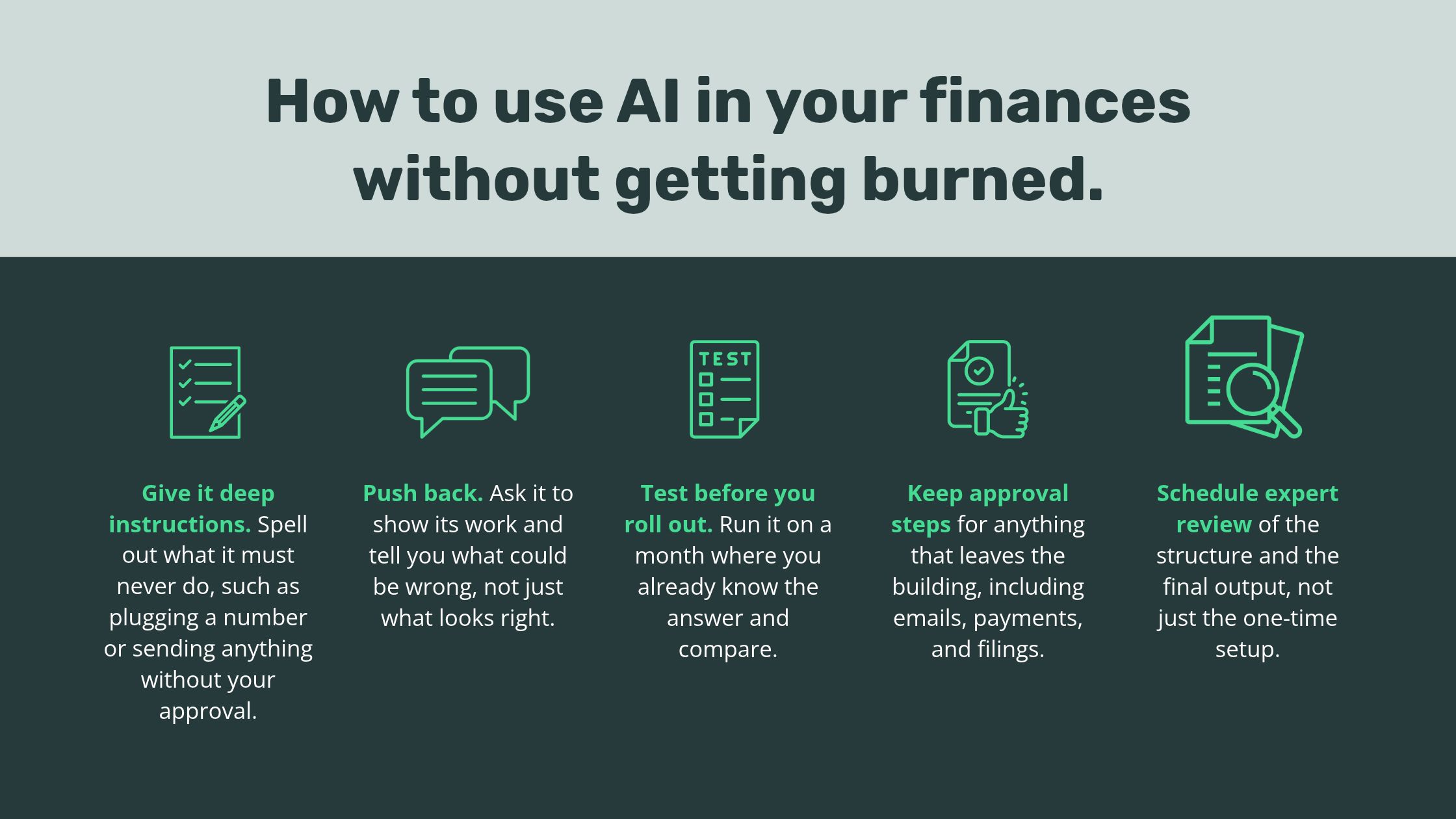
How to use AI in your finances without getting burned.
You don't have to avoid AI. You have to manage it. Here's where to start:
Give it deep instructions. Spell out what it must never do, such as plugging a number or sending anything without your approval.
Push back. Ask it to show its work and tell you what could be wrong, not just what looks right.
Test before you roll out. Run it on a month where you already know the answer and compare.
Keep approval steps for anything that leaves the building, including emails, payments, and filings.
Schedule expert review of the structure and the final output, not just the one-time setup.
AI works best when someone who understands the work is teaching it, testing it, and checking it.
Grow with it, don't brace for it.
There's a lot of fear around AI right now. We'd rather talk about partnership. The tools will keep changing, and your business will keep changing with them. What stays constant is the need for someone who understands your numbers and is watching the output.
At Calculated, we're AI-forward and human-led. We use the technology ourselves, we test it before we trust it, and we help our clients grow alongside it.